• Link to Facebook
  • Link to LinkedIn
918-663-1919
Final Touch Cleaning
  • Commercial Cleaning
        • General Cleaning
          • Day Cleaning
          • Nightly Cleaning
          • Window Cleaning
          • Construction Cleaning
          • Deep Cleaning
          • Emergency Disinfection Services
        • Hard Floor Cleaning
          • Stripping and Resealing
          • Floor Buffing
          • Floor Scrubbing
        • Carpet Cleaning
          • Carpet Extraction
          • Bonnet Cleaning
          • Upholstery Cleaning
        • Pressure Washing
          • Sidewalks
          • Parking Lots
          • Buildings
          • Concrete Sealing
  • Industries
    • Commercial Office Cleaning Services
    • Janitorial Services for Schools
    • Warehouse Cleaning Services
    • Medical Cleaning Services
    • Bank Cleaning Services
    • Church Cleaning Services
  • Areas We Serve
    • Oklahoma City
    • Tulsa
  • Resources
    • Testimonials
    • Blog
  • About
    • Leadership Team
    • Our Team
    • Clients We Serve
    • Community Outreach
    • Careers
  • Contact
  • Menu Menu

The Risks of Poor Disinfection in Medical Office Cleaning

In medical environments, cleanliness is a matter of safety, trust, and compliance. When medical office cleaning falls short, the risks are far-reaching: dangerous pathogens, patient infections, cross-contamination, and even legal action. In an industry built on health and healing, there’s no room for shortcuts. Explore the serious consequences of poor disinfection and how to prevent them with professional practices and protocols.

Why Proper Medical Office Cleaning Matters—And What’s at Stake

In healthcare settings, cleanliness is the frontline defense against infection. From waiting rooms to exam tables, every surface in a medical office has the potential to harbor harmful pathogens. Without proper cleaning and disinfection protocols, these invisible threats can spread quickly.

But routine janitorial work isn’t enough. Effective medical office cleaning goes beyond surface-level wiping and includes targeted disinfection practices, especially in high-touch areas like door handles, armrests, counters, and diagnostic equipment. When overlooked or improperly executed, the consequences can be severe.

Here are just a few dangerous pathogens that thrive in under-cleaned medical environments:

  • MRSA (Methicillin-resistant Staphylococcus aureus): A highly resistant staph bacteria that causes skin infections, pneumonia, and bloodstream infections.
  • C. difficile (Clostridioides difficile): A spore-forming bacterium that spreads via contaminated surfaces, causing severe diarrhea and inflammation.
  • Norovirus and Influenza: Highly contagious viruses that spread through contact and droplets, lingering on shared surfaces in lobbies and restrooms.
  • COVID-19: Still a major concern in medical settings, especially among immunocompromised patients.

Using the right medical disinfectant is critical, especially one that’s EPA-approved for healthcare use and proven effective against these pathogens. But it’s not just about the product; it’s also about technique. Without proper dwell time, cleaning staff may unknowingly wipe away disinfectant before it can kill harmful microbes.

Professional medical office cleaning services are trained to handle these risks. They follow strict protocols designed for healthcare environments, minimizing the chance of contamination and reducing the risk of hospital-acquired infections (HAIs).
The Consequences of Inadequate Cleaning

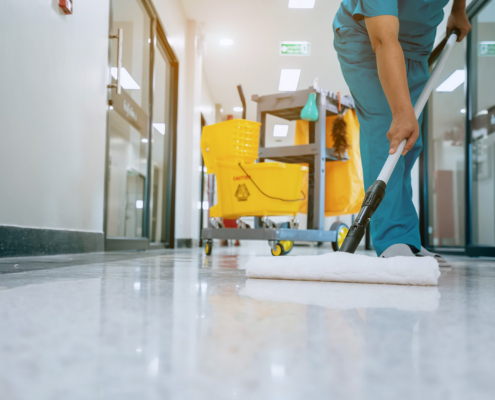
Failing to carry out proper cleaning and disinfection protocols in a medical environment can result in much more than unsightly conditions. When medical facility cleaning isn’t executed with care and precision, the long-term costs can be severe. From health risks to legal exposure, the fallout of inconsistent sanitation reaches every corner of your facility.

Hospital-Acquired Infections (HAIs)

Hospital-acquired infections are among the most dangerous and costly consequences of inadequate cleaning. These infections develop during a patient’s stay in a healthcare setting and are often the result of exposure to pathogens that should have been eliminated.

  • 1 in 31 patients contracts an HAI each day in U.S. hospitals (CDC)
  • Frequently caused by contaminated surfaces, medical equipment, and hand-contact points
  • Lead to longer hospital stays, increased treatment costs, and potential complications

Preventing HAIs begins with stringent sanitation procedures that remove pathogens before they can pose a risk to vulnerable patients.

Cross-Contamination

Cross-contamination occurs when bacteria or viruses are transferred from one surface or person to another, often through shared contact points or equipment. Without regular disinfection between patient interactions, germs can spread rapidly throughout your facility.

  • Common culprits include door handles, exam tables, keyboards, and medical tools
  • Especially dangerous in high-turnover areas like urgent care and outpatient clinics
  • Undermines infection control efforts and increases the likelihood of facility-wide outbreaks

By maintaining strict cleaning protocols between uses, medical teams can drastically reduce the chances of contamination spreading unchecked.

Legal and Financial Liability

Poor medical office cleaning can carry serious legal and financial consequences. When a patient becomes ill due to unsanitary conditions, the liability falls on the provider.

  • Facilities may face negligence claims, regulatory fines, or increased insurance premiums
  • Failed inspections from OSHA or local health departments can result in mandated closures or corrective action plans

Beyond patient harm, these failures can cripple an organization’s operations and finances, making proactive compliance non-negotiable.

Loss of Patient Trust

Perception is reality in healthcare. Even if your clinical care is top-tier, patients are unlikely to feel safe in a visibly unclean environment. Small details like dusty vents, dirty floors, or stained upholstery can quickly erode credibility.

  • Unsanitary conditions damage your reputation and discourage return visits
  • Patients may seek care elsewhere or share negative experiences publicly
  • Word-of-mouth and online reviews can affect patient acquisition and retention

Trust is fragile in healthcare, and cleanliness is a key part of maintaining it. Investing in professional cleaning reinforces the message that your facility takes health and patient safety seriously.

Routine cleaning is essential, but sometimes your facility needs more. Discover how FTCC’s deep cleaning services go beyond daily protocols to target hidden germs and high-risk areas in exam rooms, restrooms, and shared spaces.

Learn More

How to Prevent Risks: Guidelines and Proven Practices

Organizations like the CDC and OSHA provide the foundation for effective cleaning, but it’s up to each facility to ensure those guidelines become real-world habits. The following strategies combine regulatory direction with field-tested solutions that reduce liability, increase safety, and support patient trust.

Follow CDC and OSHA Standards for Medical Cleaning

The CDC and OSHA have developed strict recommendations to protect both patients and workers in healthcare environments. These standards are the baseline for any professional medical office cleaning protocol.

Key requirements include:

  • Use of EPA-registered medical disinfectants for all high-risk surfaces
  • Proper dwell time to allow disinfectants to neutralize pathogens
  • Frequent disinfection of high-touch areas (exam tables, doorknobs, counters, etc.)
  • Use of personal protective equipment (PPE) for all cleaning personnel
  • Safe disposal of contaminated materials in compliance with biohazard protocols

Following these guidelines helps prevent infection while keeping your facility compliant during audits and inspections, reducing the risk of penalties or shutdowns.

Train Staff or Hire a Medical Cleaning Partner

Even the best guidelines fall short without well-trained hands behind the work. Whether you rely on in-house staff or outsource, consistent training and oversight are key to maintaining a safe and healthy environment.

Best practices include:

  • Routine training on cleaning techniques and chemical safety
  • Clear checklists for daily, weekly, and post-visit disinfection
  • Verification procedures or audits to ensure protocols are followed
  • Use of color-coded cloths and tools to prevent cross-contamination
  • Proper storage and labeling of cleaning agents for safety and compliance

By empowering your team—or choosing a professional cleaning provider—you ensure that standards are upheld with every shift, not just during inspections.

Create a Consistent, Documented Cleaning Plan

Cleaning without a system invites inconsistency. Having a written plan tailored to your space, patient volume, and equipment types makes it easier to stay compliant and reduce risk over time.

Your plan should include:

  • Defined cleaning zones with specific responsibilities
  • Frequency charts based on usage and traffic
  • Approved product lists that align with CDC and OSHA guidance
  • Incident response protocols for exposure or contamination events
  • Regular review and updates as guidance or facility use evolves

A documented plan turns best intentions into daily action and gives you something tangible to reference during staff training, quality checks, or regulatory visits.

Protect Your Patients and Your Practice With FTCC

Partnering with a professional medical office cleaning provider ensures your space meets the highest standards of cleanliness, compliance, and care. Final Touch Commercial Cleaning delivers expert disinfection services designed to reduce infection risks, support CDC and OSHA compliance, and uphold patient trust. Contact us today to schedule a custom cleaning plan tailored to your medical facility’s needs.

Share This Post

  • Share on Facebook
  • Share on X
  • Share on WhatsApp
  • Share on Pinterest
  • Share on LinkedIn
  • Share on Tumblr
  • Share on Vk
  • Share on Reddit
  • Share by Mail

More Like This

Worker cleaning medical facility

Why Medical-Grade Cleaning Is Different From Standard Commercial Cleaning

Medical Office Cleaning
https://finaltouchcleaning.com/wp-content/uploads/2026/05/Worker-cleaning-medical-facility.jpg 1250 2000 Abstrakt Marketing /wp-content/uploads/2023/01/final-touch-logo-01-300x132.png Abstrakt Marketing2026-05-12 13:51:372026-05-12 13:51:42Why Medical-Grade Cleaning Is Different From Standard Commercial Cleaning
Areas That Require Medical Facility Cleaning

Areas That Require Medical Facility Cleaning 

General Cleaning Services, Medical Office Cleaning
https://finaltouchcleaning.com/wp-content/uploads/2025/10/Areas-That-Require-Medical-Facility-Cleaning.jpg 1250 2000 Abstrakt Marketing /wp-content/uploads/2023/01/final-touch-logo-01-300x132.png Abstrakt Marketing2025-10-01 17:37:152026-05-07 20:28:33Areas That Require Medical Facility Cleaning 

How to Create a Medical Cleaning Service Schedule

Medical Office Cleaning
https://finaltouchcleaning.com/wp-content/uploads/2025/08/Creating-a-Cleaning-Schedule-for-Medical-Offices.jpg 1250 2000 Abstrakt Marketing /wp-content/uploads/2023/01/final-touch-logo-01-300x132.png Abstrakt Marketing2025-08-26 13:40:432026-05-07 20:28:33How to Create a Medical Cleaning Service Schedule

How Medical Office Cleaning Reduces Contamination

Medical Office Cleaning
https://finaltouchcleaning.com/wp-content/uploads/2025/08/The-Role-of-Cleanliness-in-Reducing-Cross-Contamination-in-Medical-Offices.jpg 1250 2000 Abstrakt Marketing /wp-content/uploads/2023/01/final-touch-logo-01-300x132.png Abstrakt Marketing2025-08-26 13:17:222026-05-07 20:28:33How Medical Office Cleaning Reduces Contamination
Why Healthcare Centers Need Medical Facility Cleaning Solutions

Why Healthcare Centers Need Medical Facility Cleaning Solutions

Medical Office Cleaning
https://finaltouchcleaning.com/wp-content/uploads/2025/08/Why-Healthcare-Centers-Need-Medical-Facility-Cleaning-Solutions.jpg 1250 2000 Abstrakt Marketing /wp-content/uploads/2023/01/final-touch-logo-01-300x132.png Abstrakt Marketing2025-08-07 11:47:472026-05-07 20:28:33Why Healthcare Centers Need Medical Facility Cleaning Solutions

The Value of Medical Office Cleaning vs. Traditional Cleaning

Commercial Cleaning, Medical Office Cleaning
https://finaltouchcleaning.com/wp-content/uploads/2024/10/The-Value-of-Medical-Office-Cleaning-vs.-Traditional-Cleaning.jpg 1250 2000 Abstrakt Marketing /wp-content/uploads/2023/01/final-touch-logo-01-300x132.png Abstrakt Marketing2024-10-07 15:57:222026-05-07 20:28:37The Value of Medical Office Cleaning vs. Traditional Cleaning
Nurse making the bed at a hospital

Why Hospital Cleaning Services Are Important

Medical Office Cleaning
https://finaltouchcleaning.com/wp-content/uploads/2024/08/Nurse-making-the-bed-at-a-hospital.jpg 1250 2000 Abstrakt Marketing /wp-content/uploads/2023/01/final-touch-logo-01-300x132.png Abstrakt Marketing2024-08-19 13:02:592026-05-07 20:28:37Why Hospital Cleaning Services Are Important
Previous Previous Previous Next Next Next

Categories

  • Carpet Cleaning
  • Churches
  • Commercial Cleaning
  • Commercial Disinfecting Services
  • Construction Cleaning
  • General Cleaning Services
  • Hard Floor Cleaning
  • Industries
  • Medical Office Cleaning
  • Office Cleaning Services
  • Partners
  • Pressure Washing
  • Schools
  • Window Cleaning

Contact Us

"*" indicates required fields

This field is for validation purposes and should be left unchanged.

About Us

Final Touch Commercial Cleaning provides a wide range of custom cleaning services for businesses in Tulsa and nearby regions.

What We Do

General Cleaning

Hard Floor Cleaning

Carpet Cleaning

Pressure Washing

Contact Us

10404 E. 55th Place
Suite C
Tulsa, Ok, 74146

918.663.1919


Website by Abstrakt Marketing Group ©
  • Privacy Policy
  • Sitemap
  • Linkedin
  • Facebook
Scroll to top Scroll to top Scroll to top

This site uses cookies. By continuing to browse the site, you are agreeing to our use of cookies.

AcceptLearn more

Cookie and Privacy Settings


How we use cookies

We may request cookies to be set on your device. We use cookies to let us know when you visit our websites, how you interact with us, to enrich your user experience, and to customize your relationship with our website.

Click on the different category headings to find out more. You can also change some of your preferences. Note that blocking some types of cookies may impact your experience on our websites and the services we are able to offer.

Essential Website Cookies

These cookies are strictly necessary to provide you with services available through our website and to use some of its features.

Because these cookies are strictly necessary to deliver the website, refusing them will have impact how our site functions. You always can block or delete cookies by changing your browser settings and force blocking all cookies on this website. But this will always prompt you to accept/refuse cookies when revisiting our site.

We fully respect if you want to refuse cookies but to avoid asking you again and again kindly allow us to store a cookie for that. You are free to opt out any time or opt in for other cookies to get a better experience. If you refuse cookies we will remove all set cookies in our domain.

We provide you with a list of stored cookies on your computer in our domain so you can check what we stored. Due to security reasons we are not able to show or modify cookies from other domains. You can check these in your browser security settings.

Other external services

We also use different external services like Google Webfonts, Google Maps, and external Video providers. Since these providers may collect personal data like your IP address we allow you to block them here. Please be aware that this might heavily reduce the functionality and appearance of our site. Changes will take effect once you reload the page.

Google Webfont Settings:

Google Map Settings:

Google reCaptcha Settings:

Vimeo and Youtube video embeds:

Accept settingsHide notification only